Signs

I’ve been an atheist for about 20 years, and I don’t really believe in an afterlife, at least not one where we’re all floating around in the clouds and hanging out with deceased loved ones at some kind of giant, cosmic cocktail party. I definitely don’t believe in up or down, reward or punishment, heaven or hell. But I do believe all life is connected, and going on what astrophysicists like Neil deGrasse Tyson and theoretical physicists like Lawrence Krauss say about all of us consisting of atoms from exploded stars, I have a little theory that that when we first meet people or creatures with whom we click instantly or who already seem familiar to us, we might have a few atoms from the same star.

I’m also a bit, shall we say, “sensitive.” For example, I get “lead legs” and feel like I’m being pulled into the ground in certain places like the Alamo, Gettysburg, crime scenes, and random graves, usually the graves of those who suffered greatly in life or died violently. It’s not all bad, however. I also get “boosts,” a feeling of being uplifted. I get that at Congressional Cemetery, which is very much woven into the local community as a place to gather for various events ranging from book clubs to movie nights to 5K runs. I also got it at the non-endowed section of Spokane’s Greenwood Memorial Terrace, where people make their own memorials to mark graves and maintain the gravesites out of the goodness of their hearts. Point is, I’m not so entrenched in, and closed off by, my atheism and my work as a science-focused medical journalist that I rule out the metaphysical, the things we cannot explain with the scientific method and our physical senses. Hey, I even read tarot.

So let me share a few things with you, things that happened soon after Inigo and I said goodbye.

First, I haven’t heard Kenny Rogers’ “Through the Years” in many years. Friday night I was lying under the birdie quilt, the one I used to use to make a tent for Inigo to do his wood chipping. I was trying to find peace in the stillness, and that song popped into my head. Inigo loved country music. I’m not a fan of it, myself, but he loved twangs, banjos, and anything with a country feel to it, and Kenny Rogers was a country king.

Second, a tiny black feather from Inigo’s head was on the floor outside my bedroom door the morning after we said goodbye. I could swear it wasn’t there when I went to bed the night before. I vacuum every night, a habit begun upon getting birds because they fling food and chewed-up toy parts around, and a habit continued because I scatter seeds on my balcony for wild birds and no matter how much I wipe my shoes on a bristly mat before coming back in, I always manage to traipse some seeds back into the apartment. I would have seen that little feather and started bawling.

Third, later that same morning I decided to hook up my laptop speakers and listen to a playlist I had saved on Spotify but not yet listened to, Nordic Acoustic Guitar. I was going to listen to it when we had a decent snowfall, perhaps while doing a jigsaw puzzle or just sitting with Inigo and looking out the window, a favorite pastime of ours that also reminded me of Jimmy the Green Cheek, who used to love watching big snowflakes fall. I had no idea what was on the playlist, but “Nordic” and “snow” seemed like a good combination, and I had forgotten about it since I saved it because it has been an unusually warm winter where I live. Well, look at the first song on the list.

When I got home after our goodbye, I cleaned out Inigo’s house. It broke my heart to see his toys, his perches, his food and water bowls like he was going to come back to them. On his last two days here, he ate out of a little dipping bowl on his birdie shelf because he couldn’t get across his rope perch to his regular food bowl. There were seed husks and bird pellet powder and crumbs on his towels, reminders that he had been chowing down there just a couple of hours before we said goodbye. Looking at it all felt like I was being kicked in the chest.

Yet when I looked at his empty house the next day, it felt cold and sterile. It was like when I moved out of one of my better apartments. Inigo and I had many balcony dinners there, and many pasta nights, movie nights, and silly dances, and it was the apartment we had for the first year pandemic. Our stuff and our fun made it a home. But when I went back for the final inspection with the landlord, I was struck by how it didn’t feel like anything anymore. It had become just a collection of walls, doors, and windows.

Seeing Inigo’s empty house felt the same way, an empty shell, just cage bars and a shelf, and it was almost as unbearable as seeing the little food mess around the dipping bowl. Who was I to remove Inigo’s things? It was his house, one he had lived in for 21 years, with his bowls and his shelf and his perches. It was his.

As I stood in front of it, wondering what to do, I got the urge to put the little towels he used to sleep on back onto his birdie shelf. Then I got the sense that he was telling me he didn’t need food, water, or perches because he doesn’t have his body anymore and now he can fly from place to place and land wherever he likes, but he wanted a comfy place to hang out, a place where he had felt relaxed and cherished.

When I put the towels back, an enormous love filled the room. I struggle to describe it. It was simultaneously soft and bright, both gentle and overpowering, and so warm that it seemed almost tangible. Since then, I’ve felt Inigo’s presence. He comes and goes, but he’s still around. It appears that he has claimed the space over and around my right shoulder, the space where he would fly alongside me if I left the room without him already on me, back when he could fly, before his arthritis.

My ex-husband noticed that was were Inigo flew, actually. My ex and I used to wear our birds when we folded laundry, kind of a family chore thing, but sometimes Louise the Alexandrine (who now lives with him) wasn’t in the mood, and one night he had Inigo on his shoulder instead. I left the room for some reason, maybe to go bring up another load of laundry to dump on the bed and sort, and Inigo flew after me down a long hallway. My ex-husband said it was one of the most touching things he had ever seen, a girl and her bird.

“That little bird loves you so.”

Maybe it was Inigo’s love filling my living room when I put the towels back on the birdie shelf.

I can feel him now as I write this, actually. He’s hanging out on my right shoulder, a place he hadn’t hung out in many years because of his arthritis and because, to be honest, I’m not a fan of birds on shoulders, and neither have been most of the veterinarians I’ve known. There’s a reason pirates wear eye-patches. But Inigo is there now, watching the words as they fill the screen.

Some of my friends have said that Inigo was a soulmate to me, and that’s true. He was my constant companion for 21 years, through marriage, divorce, eight apartments, eight years of freelancing, six jobs, a few relationships or variations thereof, several deaths in the family (including that of Jimmy the Green Cheek), two major surgeries, two interstate moves, and one pandemic, and now he’s here letting me know he’s free and okay. Maybe it’s our stardust.

Emmie

One of my little rules is that I don’t work on Friday nights. Not job work, not house work, not errands. But I have a pretty busy weekend planned, and I knew I wouldn’t get up early tomorrow to do grocery shopping, so I set out to do so tonight. I really didn’t want to go, and I put it off, knowing, and dreading, that I was going to have to walk through the nightlife part of town. There would be a lot of people out, it would be noisy, and leftovers from happy hour would be stumbling around like revenants looking for a second life. I mumbled. I grumbled. I took the trash out. Procrastinate, procrastinate, procrastinate.

I gathered my things and got to the elevator before I realized I didn’t have any tissues with me. I carry them not so much for myself, although there’s that, but also because sometimes I find dead birds. I cannot bear to leave them on the sidewalk or street, where people will step around them with a look of disgust and maybe kick them aside, kids will poke them with sticks, and dogs will chew them up, so I pick them up with a tissue and lay them to rest under trees or shrubs. My mood darkening yet further, I went back to my apartment and stuffed a few tissues in my bag.

About ten minutes into my walk I hit the strip. Sure enough, there were what seemed like a million people out, and good on ’em. They were seeing friends, having dinner, window-shopping, getting ice cream…and stepping around a little round bird. She was tiny, barely the size of a golf ball, a fledgling. And she was trying over and over to fly, only to crash into storefront windows, parked cars, trash bins, and a tree. People were pausing, watching, saying “awwww,” moving along.

Normally, when you find a fledgling—a fully feathered, or nearly fully feathered, baby bird that is learning to fly—it is best to leave it where it is. Its parents are nearby and will continue to take care of their little one even if it’s grounded. I looked for the nest and couldn’t see one. I listened, and I didn’t see or hear any parents. Sometimes parent birds get frantic in situations like that.

Flutter, crash, flutter, crash.

The little one was exhausting herself. More people came. Some had dogs, and I got between them and the bird. She landed on a tree trunk and tried to climb, only to flutter to the ground.

I took out my phone and looked for local wildlife rehabilitators. I left a message with one and the recording said they would call back in 30 minutes.

Fifteen minutes went by.

Flutter, crash, flutter, crash.

Some guys came toward us with their dog. I asked them to stay back. When they saw her they said “sure” and “absolutely,” and asked me if she would be all right. I said I was trying to get her help. As they walked away one looked over his shoulder and said, “Thank you for doing that.”

I began to get out my phone to look for another wildlife rehabilitator. As I was digging through my purse, I looked down at the little one, told her I wouldn’t hurt her, and asked her if she was okay.

She looked at me, and then she flew up toward me, right at me, so help me, right toward my heart. I held out my hand and she landed in it. Just landed in it all by herself. She was cool to the touch—not a great sign—and she hunkered down into my palm to warm up, so I held her. Here she is:
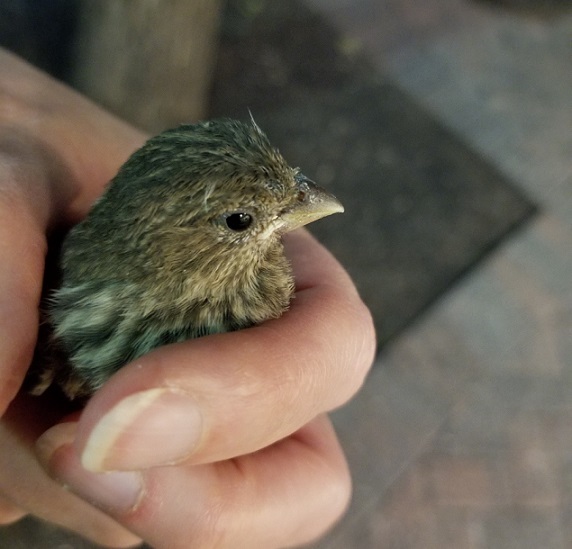
I sat on a bench and another fifteen minutes went by. Baby birds need to eat every half hour, and I was getting worried. She seemed content nestled in my hand, and she gave me quite a fright when she closed her eyes and took a little nap because I thought for a moment that she had died.

So there I was, empty grocery bags strewn out beside me, my glasses askew on my head, trying to find a wildlife rehabilitator on my phone with one hand, holding a precious fledgling in the other, trying not to cry and failing. A mother and her daughter came out of the ice cream shop, asked me how the little one was doing—which was just enough interaction to force me to compose myself—and left. The only two wildlife rehabilitators I could find worked with mammals, so I called the first one on the list, who worked with opossums.

We spoke for about five minutes, and she said that the tragedy in these situations is that with so many people around, even if the parents were around, they wouldn’t have flown down to their baby. We both knew this little one would not have stood a chance, especially as there would soon be drunken revelers filling the sidewalks. Someone would have stepped on her, either accidentally or deliberately, so once she perked up and started getting squirmy in my hand, I put her in one of my reusable shopping bags, called an Uber, and took her to the lady’s house.

Once she saw the little one, she knew it was the right thing that I removed her from the area. She said this wee one was sufficiently developed that she would probably eat—any younger and they often won’t eat from anyone but the parents—and she would take care of her and eventually release her in a park behind her house.

Funny part is, after we got to talking for a few minutes, it turned out that this woman grew up in Manhattan and her mother’s best friend is from my hometown on Long Island, so she knew my hometown well. It is indeed a small world, and we’re all connected somehow.

I called another Uber and texted a few friends on the way home. It’s a running joke that I’m the one who talks to birds, not unlike how Linus Van Pelt in Peanuts used to pat Woodstock and other birds on the head. And I just had to share the story.

The ride home made me a little carsick, and by the time I got up to my apartment the evening had begun to catch up to me. I washed up and took care of my own bird, making sure to apologize for coming home without his nanners. After a few more texts, one of my friends said “your heart must be so full right now,” and it’s a good thing I had those tissues nearby.

Indeed my heart is full in a way it hasn’t been for a very long time. That this sweet, fragile little bird trusted me enough to fly to me for help is something I will cherish for the rest of my life. Holding her, watching her settle in, knowing that she knew I wouldn’t hurt her and that I would do my best to help her, sensing the gratitude coming from her even in her exhaustion—if I could share that feeling with the entire world, I would.

Little one, I don’t know what your parents named you, but to me you seemed like an Emmie, so I hope it’s okay that I think of you with that name. I hope you have a good night’s sleep, and that you will grow to have a happy, birdie life. Thank you for trusting me and allowing me to help you, and I hope that somehow your parents understand that you came to no harm in my hands and are now safe. Wherever you may fly, you will always be loved.