Beautiful night tonight, so I decided to get some miles in and walk home. It’s about 7 miles, or 2.5 hours. My favorite parts are the the paths on either side of the Reflecting Pool in front of the Lincoln Memorial and the walk over Memorial Bridge. The Crows were just heading to their Arlington roost when I got to the bridge, an endless dark ribbon of thousands of birds gliding over the river. Every once in a while a couple of them would collide seemingly intentionally, like they were messing around and playing aerial bumper cars for the heck of it.
My least favorite part is the stretch of Fairfax Drive between N. Meade Street and N. Pierce Street. It’s Death Valley for the Crows, a dip in the road where they can’t see the cars coming as idiotic, self-important humans gun their engines to make the light at the intersection of where N. Ft. Myer Drive becomes N. Meade and Fairfax Drive. I’ve lost count of the flattened Crows I’ve seen, their bodies crushed into the asphalt. One little fledgling was ground into the double yellow lines, likely on his/her maiden flight.
Every once in a while, like tonight, I’ll find dead Crows by the side of the road or in the grass. If I can bury them, I will, but tonight’s pair were nothing more than feathers and bones. The one in a parking space was so far gone as to be a pile of feathers and a rib cage mixed with leaves and the random detritus humans leave behind to poison the landscape—string, a bottle cap, a baby’s sock, some sort of black plastic. I couldn’t tell where the Crow’s head had been, as the wing feathers were pointed every which way. The one on the grass still had his/her form, but the body and all of the head except the beak were gone. I apologized to both of them for humanity’s carelessness, and bid them rest in peace.
As I walked away, I reminded myself that I should just go up Wilson Blvd., where it’s all restaurants and nightlife and I’ve never seen any dead birds or creatures. But that wouldn’t have prevented my finding a squirrel sprawled out on the sidewalk about three blocks from where I live. I’ve probably seen that squirrel on my many walks to the grocery store. The two corner houses have yards and there are always squirrels scampering about. There are also a lot of squirrels in the park.
I couldn’t leave her there, where people would step over her and skirt around her with expressions of disgust on their faces. Sooner or later someone might have picked her up by the tail and thrown her in a trash can. So I got my gloves out of my naloxone kit, picked her up, and carried her. Her eyes were cloudy and her arms, neck, and legs were stiff, but her belly was still soft and slightly warm. She reminded me of Meeka (or Mica, short for Amica), the squirrel who used to sit in the tree, look in the window, and watch cartoons when I put them on for Inigo. Meeka’s tummy was also still warm when I found her a couple of years ago, after she got hit by a car.
I’m sure people thought I was mad, carrying a dead squirrel down the street, holding her with two hands before me as though I were bringing a birthday cake with lots of lit candles into a dining room. But I don’t care. She deserved better than to be left there on the sidewalk, so I buried her beneath some evergreens.
Tonight’s walk drove home something that eats away at me: We humans will never live in harmony with animals. We trap them, poison them, shoot them, and run them over when they’re in our way. We break their bodies to get eggs. We steal their babies to get milk. We crate them, bind them, pluck them, hang them, decapitate them, force-feed them, and scald them alive to feed our appetites. We call the ones strong enough to suffer a slaughter “Grade A,” and we beat, gas, electrocute, stomp, or simply toss in a pile and leave to die those who are too weak or sick to stand. We isolate them, imprison them, sicken them, cut them, burn them, inject things into them, put things in their eyes, sew devices under their skin, and amputate their limbs in the name of science.
Then we reel back in horror when we see people do any of this to cats and dogs, parrots and bunnies, hamsters and horses.
It’s cognitive dissonance on a good day, hypocrisy on a bad. I’m including myself in that: A lot of the candy I’ve featured this month has milk in it. I’m also a pescatarian, doctor’s orders. I take medications that were tested in animals, and the stent holding an artery in my heart open was tested on animals, including rabbits, pigs, dogs, sheep, rodents, goats, and nonhuman primates. I owe animals my very life.
But it fills me with an endless, bottomless sorrow that any animal comes to harm because of me. Most vegans and vegetarians can tell you about their epiphany, the moment the suffering we cause animals became real to them. Mine was in a grocery store, looking for ingredients to make a soup. I saw a package labeled “whole chicken, cut up” and those words were just so graphic, so gruesome, boom, the light went on. All I could see was the body parts still on the bird. All I could think was, “Wings…just like Inigo’s.” I started crying right there in the store.
I’m not a praying woman, but if I were, I would pray for people to come to see how all animals—and not just the cute or beautiful ones we keep as pets—deserve our compassion. All animals have emotions. All animals can be playful, grumpy, happy, tired, angry, or sad. Most have social bonds as families, herds, flocks, or other groups. They welcome others, battle others, make friends with others, and grieve others of their kind. I’d say all of them are sentient to some degree. And all of them want to live.
No candy tonight. I’m too sad.
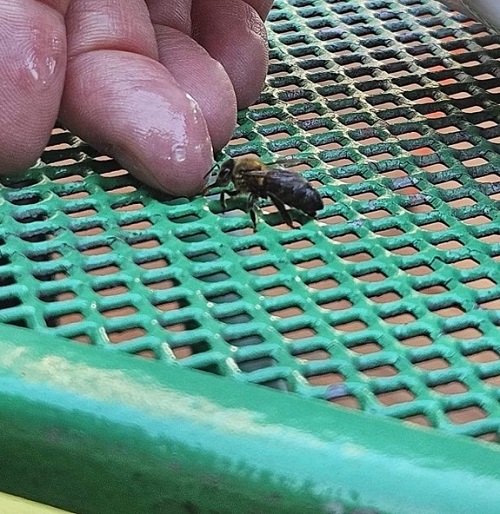
Instead, a PSA: When you see a bee in distress, like this one was after landing in my margarita, offer some sugar water. The folks at the restaurant gave me a sugar packet, I mixed it with water, and this little one drank from my fingertip and then from a drop on the table. She perked up, then after a few laps overhead, she flew away to get on with her day—hopefully without a hangover! Every little life is big to the one living it.


 zenzalei